Resonance brain-modeling
A cortical dynamics and affect-geometry project that became Resonance: algorithmic music targeted at a six-dimensional model of joy, flow, and self-model quieting.
- Resonance: algorithmic music that targets an explicit affect trajectory instead of a genre label
- Uses a cortical dynamics model with structured sparse attention as the predictive substrate
- Represents happiness as a six-dimensional coordinate over valence, arousal, integration, effective rank, compression-friction, and self-model salience
- Maps target affect into MIDI and audio, with a proposed BCI loop for closed-loop adaptation
 Title slide: "Resonance — algorithmic music that targets the geometry of happiness", with the affect vector and the beauty proportionality set small underneath. Jacob Valdez, Human Enhancement Hackathon 2026
The eight slides of the Resonance deck are below, each one placed where the page is making its argument rather than stacked in a carousel at the top. Read straight through, the images are the talk and the prose is the footnotes.
Overview
brain-model started as a set of experiments around predicted brain activity, affect, UX, and virtual EEG. The Resonance deck sharpens that into a more specific product thesis: music should not only be recommended by collaborative filtering or genre tags. It should be generated toward a desired emotional trajectory, grounded in a model of how sound changes cortical and affective state.
The deck opens on the gap directly, and states it as two lines of notation rather than as a complaint. Collaborative filtering recommends by summing ratings over users similar to — a procedure with no model of affect, no model of cortex, and no model of why. The alternative it proposes replaces the arg max over catalog items with an arg min over generator parameters: , where is a predicted affect state coming out of a cortical dynamics model. The question changes from "what else did people like this play?" to "what should I emit to land here?"
 Problem slide: "Music changes how people feel. Nobody can say exactly how." — contrasting collaborative filtering, which has no model of affect, cortex, or why, against affect-geometric targeting, which minimizes distance to a target affect state
The core object is an affect vector:
where is valence, is arousal, is integration, is effective rank or distributed richness, is compression-friction, and is self-model salience. In the deck, happiness is not treated as a single score. It is a region: , moderate , high , high , low , and low .
This framing is drawn from the larger Geometry of Affect idea in The Shape of Experience: affect coordinates are tools for reading a relational structure, not a claim that emotion is literally exhausted by six scalars. That matters for Resonance because the generator is trying to move through an affect space, not optimize a single "happy" slider.
The deck's own summary is three claims in three columns, and the rest of the talk is those three claims worked out. Affect has geometry — happiness is a point in a six-dimensional coordinate system rather than a score. Brain dynamics are predictable — structured sparse attention mirroring cortical wiring beats a dense baseline. And music maps to affect — each musical feature is a declared function of one affect dimension. The load-bearing word is one system: none of the three is interesting alone, and the pipeline only exists because the output of each is the input of the next.
 Three-column slide: "Three ideas, one system." Affect has geometry, with the six-dimensional affect vector and its definitions. Brain dynamics are predictable, with the masked attention formula, 19.6% density, and R-squared 0.837 against 0.832 dense. Music maps to affect, with tempo, mode, harmonic complexity, voice count, phrase predictability and rhythmic disruption each a function of one affect coordinate
The cortical substrate
The brain-model part of the project is the predictive engine underneath Resonance. The deck proposes a structured sparse attention model whose connectivity mirrors cortical wiring rather than using dense, unconstrained attention. The model is built around 23 cortical regions from the Destrieux atlas, 42 anatomical pathways, and a sparse attention mask with 19.6% connectivity.
The state is a typed cortical vector:
and prediction is constrained by a cortical mask:
The claimed result in the deck is small but important: the sparse model slightly outperforms a dense baseline on EEG prediction, with versus , and reports 68.8% BCI accuracy versus 59.4% for an SVM baseline. The point is not that the numbers settle neuroscience. The point is that topology can be part of the model interface: typed regions, anatomical paths, attention masks, loss weights, and scheduling become a compiler target for neural architectures.
The slide shows both halves of that claim as pictures: the 23 Destrieux regions on a right-lateral surface, and the 23×23 connectivity matrix they compile into, where colour is connection weight and the block structure along the diagonal is the network families falling out of the anatomy rather than being imposed on it. The mask is 3,579 live entries out of 18,225 — the 19.6% — and the compiler's job is exactly the arrow in the caption: topology → attention masks + loss weights + scheduling. This is where the project touches canvas-engineering, which is the typed process compiler that would emit it.
 Slide: "Structured sparse attention." Left, 23 cortical regions from the Destrieux atlas rendered on a right-lateral surface; centre, the 23-by-23 cortical connectivity matrix with block structure on the diagonal; right, the three headline figures — 19.6% connectivity, 0.837 R-squared on EEG, 68.8% BCI accuracy — with the typed cortical state vector and the masked prediction rule
This is also where the older brain-model plots still matter. They show the project before it became a music-generator pitch: predicted state dynamics, consciousness-style trajectory questions, and affective intervention experiments.
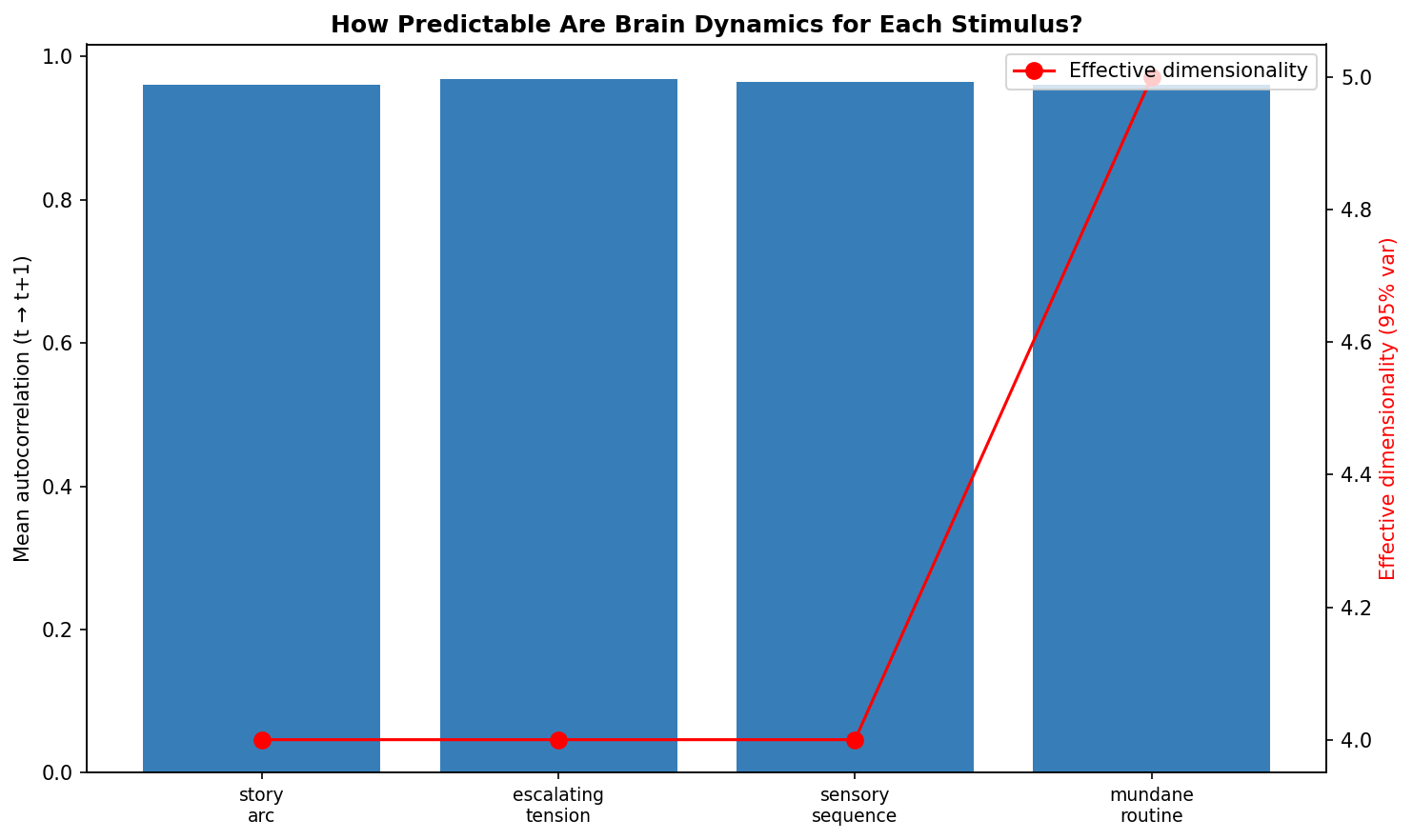 Brain state predictability plot from the brain-model repository
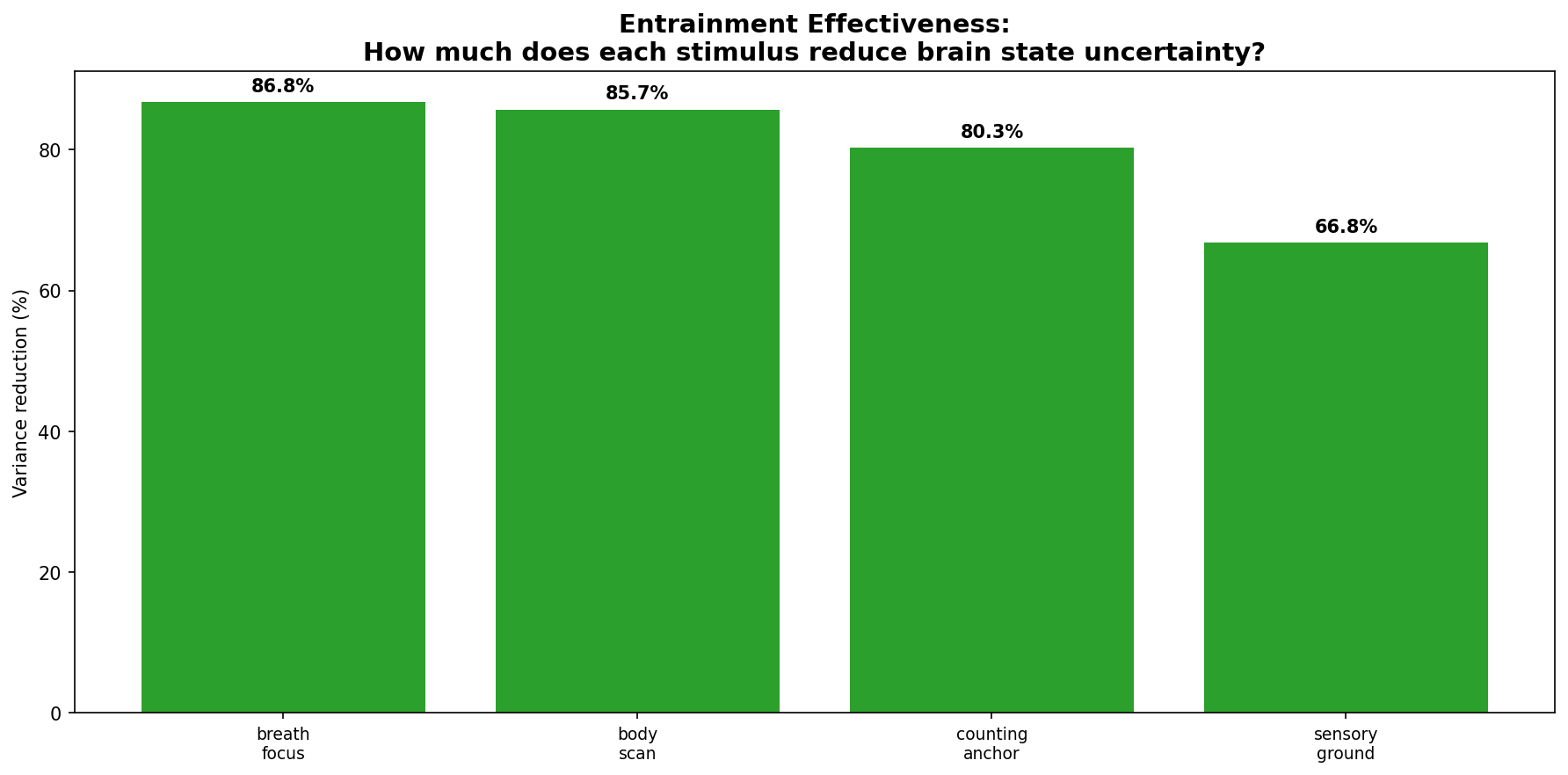 Affective intervention effectiveness plot from the brain-model repository
Affect geometry
The deck's most interesting move is to treat affect as geometry. Valence is framed through viability; arousal through belief-state change; integration through how much the whole predicts beyond decomposed parts; effective rank through how distributed the active state is; counterfactual or compression-friction weight through the compute spent on unrealized trajectories; and self-model salience through mutual information between self-state and action or affect, normalized by entropy.
The Shape of Experience page gives the same six-coordinate toolkit in a more general form: is gradient alignment on a viability manifold, is update rate, is irreducibility, is concentration versus distribution, is temporal orientation toward possible futures, and measures how prominent the self-model is in current processing.
The happiness target is therefore not "make the listener feel good" in a shallow sense. It is closer to:
That equation is doing a lot of philosophical work. It says flourishing rewards positive valence, integration, distributed representational richness, and flexibility, while penalizing the wrong amount of self-model salience and arousal. The project is implicitly suspicious of addictive engagement metrics: high arousal and high self-model salience can be powerful without being good.
The happiness-target slide is the whole six-coordinate specification written as six columns, and it is worth reading as a specification rather than as a mood board: each dimension gets a target value, the musical consequence of that value, and the estimator that would measure it. High valence means major mode and ascending contour. Moderate arousal means 90–130 BPM. High integration means coherent voice leading. Distributed effective rank means rich texture and varied register. Low compression-friction means predictable phrases. Low self-model salience means a steady groove — the condition the deck names flow, and the one that separates absorption from self-consciousness. Underneath, the flourishing functional and two named regions of the space: joy is , awe is expanding with up and down.
 Slide: "The happiness target." Six columns — valence high, arousal moderate, integration high, effective rank distributed, CF weight low, self-model low — each with its musical consequence and its estimator, over the flourishing functional and the named joy, awe and flow regions of the affect space
Music as intervention
Resonance maps the desired affect vector into musical parameters:
- arousal to tempo, roughly 60-140 BPM
- valence to mode and contour
- integration to harmonic complexity and coherent voice leading
- effective rank to voice count, register, and textural richness
- compression-friction to phrase predictability
- self-model salience to groove, absorption, and disruption
The full pipeline is:
- choose a target affect vector
- predict cortical dynamics with
- map affect into music parameters
- generate MIDI with
pretty_midi - render audio with FluidSynth
- update the loop from EEG or BCI-derived affect estimates
The optimization target minimizes , while regularizing temporal smoothness and music-theory validity. The closed loop then updates the current affect estimate toward and adjusts from the loss .
Drawn as six numbered stages, the honest structure of the project shows up immediately: stages 01 through 05 are built, and 06 — the BCI loop that closes it — is the one set in red. The deck says as much in its own schedule line underneath, splitting the work into week 1: affect engine + music gen and week 2: cortical integration + BCI loop. Everything upstream of the loop is a generator with a target; only the loop makes it an intervention with feedback.
 Pipeline slide: six numbered stages — target affect, cortical model, affect-to-music mapping, MIDI generation with pretty_midi, audio with FluidSynth, and the BCI loop in red — over the optimization objective and the closed-loop update rules
Why the beauty slide matters
The aesthetic claim in the deck is that beauty operates through resonance: aesthetic pleasure is mutual information between stimulus structure and internal model structure. In that framing, art is powerful because it changes the observer's internal basis. It does not merely decorate a pre-existing state; it installs new couplings.
The slide argues it with a painting rather than a plot, and the choice of painting is the argument. Gérôme's Pygmalion and Galatea is a picture of a sculptor's model becoming real under his hands — a stimulus that stops being an object and starts being a participant. Beside it the deck separates the aesthetic coordinate from the sublime one: aesthetic is varied valence with moderately high arousal, high integration and low self-model salience, while the sublime keeps ambivalent valence and very high arousal and drives down hard. And it names the failure mode in the same breath as the success: palette expansion is , new basis vectors genuinely installed; palette capture is — eigen-art, maximum valence swing, zero structural gain. That distinction is the difference between art and an engagement metric, and it is why the project keeps insisting the objective penalize arousal rather than reward it.
 Slide: "Beauty operates through resonance." Gérôme's Pygmalion and Galatea fills the left half; on the right, beauty as mutual information between stimulus structure and internal model structure, the aesthetic and sublime affect coordinates, and the distinction between palette expansion and palette capture
That is why Resonance belongs on the brain-model page rather than a separate toy music page. The project is really about intervention: if a model can estimate how a stimulus changes cortical-affective geometry, then music, UI, ritual, and media become controllable inputs into cognition. That makes the project both technically interesting and ethically loaded.
Current state
The repo still reads like a research notebook rather than a finished application. There are experiments around emotional stimuli, virtual EEG, consciousness dynamics, affective intervention, and brain-informed UX. The Resonance deck gives those experiments a clear integration target: a closed-loop affective music system where the cortical model predicts state, the generator proposes an intervention, and the loop adapts from measured or inferred response.
What still needs to become real:
- a concrete affect estimator that turns audio and brain-state predictions into the six-dimensional coordinate consistently
- a stronger validation story for whether generated music moves listeners toward the intended affect region
- constraints that distinguish flourishing from mere engagement, especially around high arousal and self-model salience
- a usable composition interface that exposes the affect target without forcing users to think in equations
The deck closes on a quieter version of its own title slide — the same wordmark, a different subtitle. "Algorithmic music that targets the geometry of happiness" is a pitch; "music that understands the geometry of joy" is a claim about the model, and it is the one the project has not earned yet. Everything in the list above is what stands between the two.
 Closing slide: the Resonance wordmark over the subtitle "Music that understands the geometry of joy", with the deck's full notation set very faint underneath
Deck: Resonance Presentation (PDF)
Repo: JacobFV/brain-model