tf-som
TensorFlow layers for locally competitive, self-organizing-map-style feature learning.
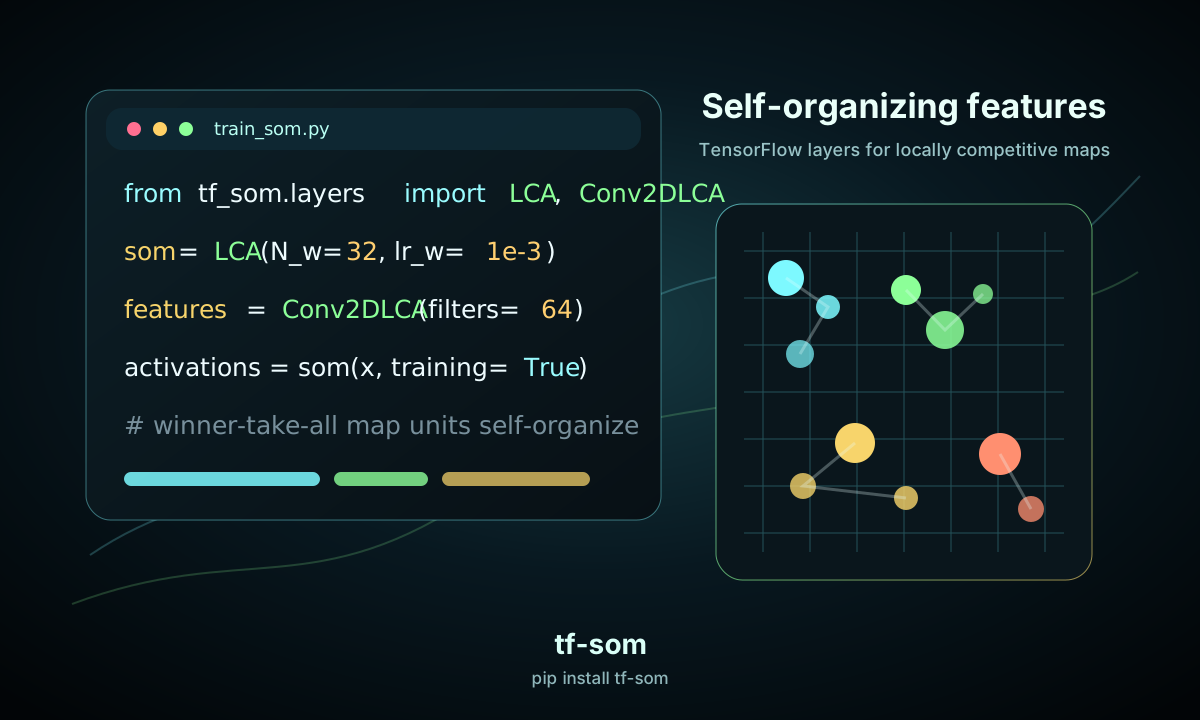 Glowing tf-som code demo showing TensorFlow SOM layers and feature clusters
Problem
Self-organizing maps are useful for unsupervised representation learning, but most Python examples live as standalone training loops instead of composable TensorFlow layers. That makes them harder to drop into image pipelines or compare against supervised convolutional baselines.
Solution
tf-som packages a locally competitive algorithm as Keras-compatible TensorFlow layers. The library exposes dense and convolutional variants, so a model can learn winner-take-all feature activations first, then freeze that unsupervised base and attach a supervised head.
from tf_som.layers import LCA, Conv2DLCA

som = LCA(N_w=32, lr_w=1e-3)
features = Conv2DLCA(filters=64, kernel_size=(3, 3))

activations = som(x, training=True)
Install from PyPI:
pip install tf-somHow
- Package: published on PyPI as
tf-som; imported in Python astf_som. - Core layer:
LCAcomputes L1 distance from inputs to learned weight vectors, converts distance to activation, and can collapse to a winner-take-all one-hot code. - Convolutional form:
Conv2DLCAunfolds image patches into local vectors, then applies the same competitive update across spatial neighborhoods. - Model helper:
ConvNetstacksLCA, pooling, andConv2DLCAlayers into an unsupervised image feature extractor. - Training behavior: during
training=True, winning units move toward observed inputs using the layer learning rate;backpropagatable=Truecan make weights trainable through TensorFlow.
Tests
The repository includes tf_som/models_test.py alongside the package source. The important checks for this kind of library are shape stability through Keras models, layer call behavior in training mode, and keeping the PyPI import path aligned with the package namespace.
Results
The project shipped as a minimal MIT-licensed TensorFlow package: github.com/JacobFV/tf-som and pypi.org/project/tf-som. It is a compact experiment in turning SOM-style local competition into reusable neural network components rather than a notebook-only algorithm.
Lessons
The main product lesson was packaging the mental model clearly. The distribution name is tf-som, the import namespace is tf_som, and the concept is easiest to understand when shown as a glowing code snippet beside a clustered feature map: input vectors compete for local units, and the winning units become a learned topological code.