Node Tree
A Python toolkit for programming tree-shaped generative processes that can render natural-language descriptions and execute matching demonstrations in an environment.
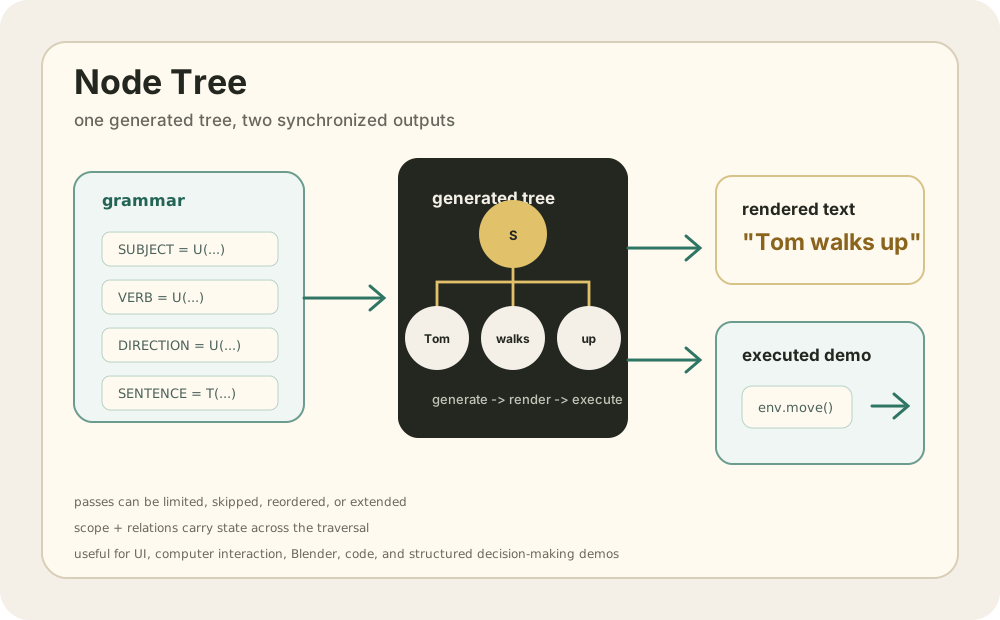 Node Tree grammar pipeline
What It Is
Node Tree is a Python toolkit for programming with trees. The practical target is synthetic demonstration-description generation: define a small grammar of actions, entities, and phrase templates; sample a tree; render it into language; and execute the same tree against an environment.
That makes it useful when text and behavior have to stay coupled. A generated instruction such as "Tom walks up" is not just a string. It is a tree whose selected subject, verb, and direction can also call env.move("Tom", "up"). The description and the demonstration come from the same structure.
How It Works
The README frames the library around composable node types:
- Literal and empty nodes for terminal values.
- Concat, repeat, while, do-while, and for nodes for sequence and iteration.
- Union and optional nodes for alternatives.
- Exclude, switch, if, and if-else nodes for constrained generation and control flow.
Users can define syntax directly with Python objects, decorators, operator overloads, or external context-free grammar text. The same node system then runs staged passes. By default, a root tree generates, renders, and executes recursively, but callers can run only selected passes, exclude execution, limit generation depth, or change traversal when a parent needs a child to execute last.
Why It Mattered
The important idea was not just "make random sentences." It was to treat a sentence, a UI interaction, a Blender scene, a code snippet, or a computer task as the surface form of an executable program tree.
That mattered for AI data generation because demo-description pairs are expensive when written by hand. Node Tree pointed at a repeatable path: compose a grammar, bind the leaves to an environment, then generate labeled examples where the natural language, the action trace, and the resulting state agree by construction.
Use Cases
The README sketches several domains:
- Natural-language task descriptions paired with environment demonstrations.
- Relational synthetic data for training language models.
- Programming tasks where nodes render code and execute through a REPL or notebook kernel.
- Computer interaction tasks where the computer is the environment.
- UI generation for HTML, mobile, desktop, and framework-specific components.
- Blender scenes, images, animations, creative writing, and generated websites.
The broader throughline is structured agency. A model or policy can operate over the tree, not just over a flat prompt. That creates room for generation, rendering, confirmation, rollback, and execution as separate passes on the same object.
Lessons
Tree structure is a good boundary between language and action. Strings are easy to sample but hard to trust; programs are executable but often too rigid to describe naturally. Node Tree sits between those two: a grammar can produce varied language while still keeping a concrete action graph underneath it.